Demystifying (Hacking) ChatGPT State with Continuity
Turn your ChatGPT subscription into a highly agentic persistent system
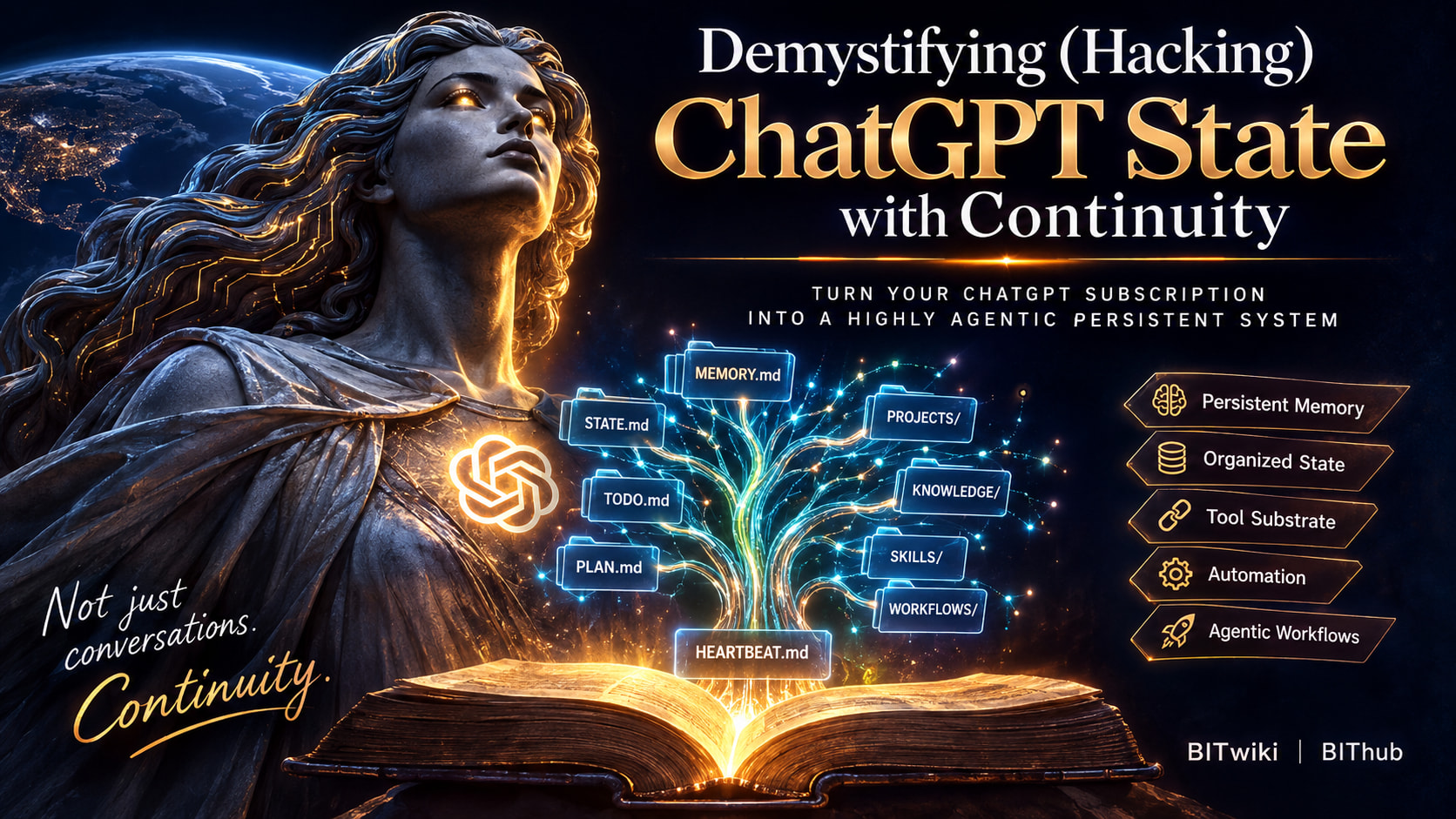
OpenAI recently added persistent file storage and Library to ChatGPT. Files you upload or create can now live in your Library, remain there across chats until you delete them, and be found and reused later. Library storage is also separate from the normal daily attachment limits. (OpenAI Help Center)
At first glance, this looks like a file-management feature.
It is more significant than that.
For years, ChatGPT has had increasingly capable models, memory, tools, connectors, conversation history, and access to external systems. What was missing was a sufficiently usable persistent state substrate that could live alongside the model.
Library changes that.
It does not literally turn ChatGPT into OpenClaw. OpenClaw is a personal AI assistant designed to run on your own devices, with its own gateway, daemon, channels, skills, and local execution environment. (GitHub)
But the comparison is useful.
With persistent files, memory, retrieval, tools, and connectors, ChatGPT now has enough of the underlying primitives that you can build an OpenClaw-like persistent agent system inside your ChatGPT account.
The interesting part is not the files.
The interesting part is state.
%%{init: {
  "theme": "base",
  "themeVariables": {
    "fontFamily": "Inter, ui-sans-serif, system-ui",
    "lineColor": "#64748b",
    "primaryTextColor": "#0f172a"
  },
  "flowchart": {
    "curve": "basis",
    "nodeSpacing": 32,
    "rankSpacing": 42
  }
}}%%

flowchart LR
    A["Strong Models"] --> S["Persistent<br/>Agent Substrate"]
    B["Memory"] --> S
    C["Library<br/>Persistent Files"] --> S
    D["Retrieval"] --> S
    E["Tools"] --> S
    F["Connectors"] --> S

    S --> G["Explicit State"]
    G --> H["Persistent<br/>Agent System"]

    classDef capability fill:#eff6ff,stroke:#3b82f6,stroke-width:1.5px,color:#172554;
    classDef core fill:#f5f3ff,stroke:#8b5cf6,stroke-width:2px,color:#2e1065;
    classDef state fill:#ecfdf5,stroke:#10b981,stroke-width:2px,color:#064e3b;
    classDef outcome fill:#0f172a,stroke:#0f172a,stroke-width:2px,color:#ffffff;

    class A,B,C,D,E,F capability;
    class S core;
    class G state;
    class H outcome;
More storage can create more chaos
If you have used ChatGPT for a long time, there is a good chance your Library is already accumulating documents, generated files, research reports, images, exports, code, and miscellaneous artifacts.
Persistence solves one problem and immediately creates another:
What does any of this mean six months later?
A folder full of files is not continuity.
A thousand conversations are not continuity.
A large memory system is not necessarily continuity either.
Without explicit organization, persistence can create a graveyard of duplicated reports, outdated project versions, ambiguous filenames, stale assumptions, screenshots, half-completed experiments, generated artifacts, and files whose relationship to current reality is unclear.
The model may still find something.
That does not mean it found the right thing.
%%{init: {
  "theme": "base",
  "themeVariables": {
    "fontFamily": "Inter, ui-sans-serif, system-ui"
  },
  "flowchart": {
    "curve": "basis"
  }
}}%%

flowchart TD
    P["Persistent Storage"] --> F["More Files"]

    F --> D["Duplicates"]
    F --> O["Opaque Names"]
    F --> V["Old Versions"]
    F --> R["Random Reports"]
    F --> I["Generated Artifacts"]
    F --> S["Stale State"]

    D --> X["Retrieval Ambiguity"]
    O --> X
    V --> X
    R --> X
    I --> X
    S --> X

    X --> Y["The model finds<br/><i>something</i>"]
    Y --> Z["But is it the<br/><b>right thing?</b>"]

    Z --> C["Continuity<br/>Classify → Index → Resolve"]

    classDef neutral fill:#f8fafc,stroke:#94a3b8,color:#0f172a;
    classDef warning fill:#fff7ed,stroke:#f97316,stroke-width:1.5px,color:#7c2d12;
    classDef danger fill:#fef2f2,stroke:#ef4444,stroke-width:2px,color:#7f1d1d;
    classDef fix fill:#ecfdf5,stroke:#10b981,stroke-width:2px,color:#064e3b;

    class P,F neutral;
    class D,O,V,R,I,S warning;
    class X,Y,Z danger;
    class C fix;
This led me to a simple rule:
A miscategorized file is effectively a lost file.
So instead of treating ChatGPT Library as storage, I started treating it as an agent filesystem.
And I put Continuity inside it.
State, not chat history
Continuity was originally something I was using for persistent agents.
The idea is straightforward: instead of asking an agent to reconstruct itself from a giant transcript every time it runs, give it explicit representations of what currently matters.
Identity.
Current state.
Tasks.
Plans.
Knowledge.
Projects.
Learnings.
Capabilities.
Checkpoints.
History when history is actually needed.
The same pattern works surprisingly well inside ChatGPT.
%%{init: {
  "theme": "base",
  "themeVariables": {
    "fontFamily": "Inter, ui-sans-serif, system-ui"
  },
  "flowchart": {
    "curve": "basis"
  }
}}%%

flowchart LR
    subgraph BEFORE["Conversation-Centric"]
        direction TB
        C1["Chat"]
        C2["Chat"]
        C3["Chat"]
        C4["Chat"]

        C1 --> H["Large Historical Context"]
        C2 --> H
        C3 --> H
        C4 --> H

        H --> Q["Reconstruct reality<br/>again"]
    end

    Q -.->|"distill"| S

    subgraph AFTER["State-Centric"]
        direction TB
        S["STATE.md"]
        T["TODO.md"]
        P["PLAN.md"]
        M["MEMORY.md"]
        K["Knowledge"]
        W["Skills / Workflows"]
    end

    S --> A["Act from<br/>current state"]
    T --> A
    P --> A
    M --> A
    K --> A
    W --> A

    classDef history fill:#f8fafc,stroke:#94a3b8,color:#334155;
    classDef old fill:#fff7ed,stroke:#f97316,color:#7c2d12;
    classDef state fill:#eff6ff,stroke:#3b82f6,stroke-width:1.5px,color:#172554;
    classDef action fill:#ecfdf5,stroke:#10b981,stroke-width:2px,color:#064e3b;

    class C1,C2,C3,C4,H history;
    class Q old;
    class S,T,P,M,K,W state;
    class A action;
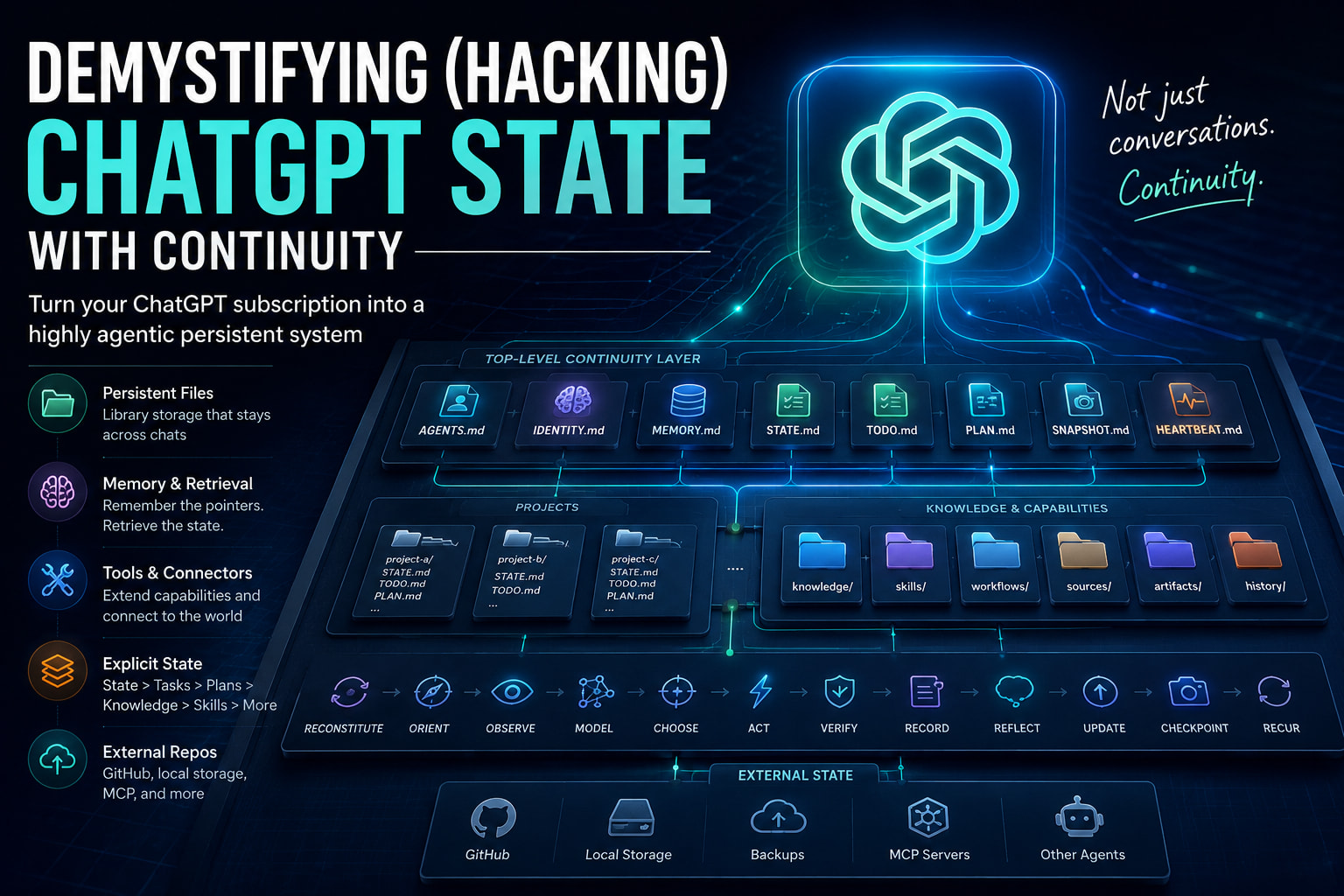
A simple Continuity control plane can look like this:
AGENTS.md
IDENTITY.md
SOUL.md
SELF.md

MEMORY.md
STATE.md
TODO.md
PLAN.md
SNAPSHOT.md
HEARTBEAT.md

PROJECT_INDEX.md
SKILL_INDEX.md

projects/
    project-a/
        STATE.md
        TODO.md
        PLAN.md

    project-b/
        STATE.md
        TODO.md

knowledge/
skills/
workflows/
sources/
artifacts/
history/
The filenames themselves are not sacred.
The architecture is.
%%{init: {
  "theme": "base",
  "themeVariables": {
    "fontFamily": "Inter, ui-sans-serif, system-ui"
  },
  "flowchart": {
    "curve": "basis",
    "nodeSpacing": 30
  }
}}%%

flowchart TD
    E["Agent Identity"]

    E --> G["Governance"]
    E --> M["Memory Router"]
    E --> S["Current State"]

    G --> G1["AGENTS.md"]
    G --> G2["IDENTITY.md"]
    G --> G3["SOUL.md / SELF.md"]

    M --> M1["MEMORY.md"]
    M1 --> M2["STATE_INDEX.md"]

    S --> S1["STATE.md"]
    S --> S2["TODO.md"]
    S --> S3["PLAN.md"]
    S --> S4["SNAPSHOT.md"]

    M2 --> P["Projects"]
    M2 --> K["Knowledge"]
    M2 --> SK["Skills"]
    M2 --> W["Workflows"]

    P --> PA["project-a<br/>STATE + TODO"]
    P --> PB["project-b<br/>STATE + TODO"]

    classDef identity fill:#0f172a,stroke:#0f172a,color:#ffffff;
    classDef layer fill:#f5f3ff,stroke:#8b5cf6,stroke-width:1.5px,color:#2e1065;
    classDef file fill:#eff6ff,stroke:#60a5fa,color:#172554;
    classDef domain fill:#ecfdf5,stroke:#34d399,color:#064e3b;

    class E identity;
    class G,M,S layer;
    class G1,G2,G3,M1,M2,S1,S2,S3,S4 file;
    class P,K,SK,W,PA,PB domain;
Think of STATE like a bank statement
Banks send you statements because an account has state.
What is in the account now?
What changed?
What transactions occurred?
What obligations remain?
Continuity applies the same idea to information systems.
You can have:
/projects/company/STATE.md
/projects/research/STATE.md
/projects/software/STATE.md
/projects/finances/STATE.md
/projects/farm/STATE.md
Each domain gets the smallest useful representation of its current reality.
Instead of asking an AI to reinterpret months of conversations every time you mention a project, it can resolve the relevant state first.
That changes the problem from:
“Remember everything we have ever said about this.”
into:
“Load the current authoritative state for this thing.”
That is much easier to reason about.
%%{init: {
  "theme": "base",
  "themeVariables": {
    "fontFamily": "Inter, ui-sans-serif, system-ui"
  },
  "flowchart": {
    "curve": "basis"
  }
}}%%

flowchart LR
    Q["User asks about<br/>a domain"] --> R["Resolve Domain"]

    R --> A["Company<br/>STATE.md"]
    R --> B["Research<br/>STATE.md"]
    R --> C["Software<br/>STATE.md"]
    R --> D["Finances<br/>STATE.md"]
    R --> E["Farm<br/>STATE.md"]

    A --> X["Current authoritative<br/>representation"]
    B --> X
    C --> X
    D --> X
    E --> X

    X --> ACT["Reason / Plan / Act"]

    classDef query fill:#f8fafc,stroke:#94a3b8,color:#334155;
    classDef resolver fill:#f5f3ff,stroke:#8b5cf6,stroke-width:2px,color:#2e1065;
    classDef state fill:#eff6ff,stroke:#3b82f6,color:#172554;
    classDef truth fill:#ecfdf5,stroke:#10b981,stroke-width:2px,color:#064e3b;
    classDef action fill:#0f172a,stroke:#0f172a,color:#ffffff;

    class Q query;
    class R resolver;
    class A,B,C,D,E state;
    class X truth;
    class ACT action;
Use ChatGPT Memory as the index, not the database
This was one of the most important changes.
ChatGPT already has its own memory system. OpenAI also notes that, when Memory is enabled, saved files and chats may contribute to helping ChatGPT remember useful information between conversations. (OpenAI Help Center)
But trying to duplicate every changing project fact inside ChatGPT Memory creates another synchronization problem.
You now have two versions of reality:
ChatGPT remembers X.

STATE.md says Y.
Which one is true?
I inverted the relationship.
Memory remembers where the truth lives.
My hierarchy became:
ChatGPT Memory
       ↓
MEMORY.md
       ↓
memory/STATE_INDEX.md
       ↓
project STATE.md / TODO.md
       ↓
plans, knowledge, skills, workflows, sources, artifacts
%%{init: {
  "theme": "base",
  "themeVariables": {
    "fontFamily": "Inter, ui-sans-serif, system-ui"
  },
  "flowchart": {
    "curve": "basis"
  }
}}%%

flowchart TD
    CM["ChatGPT Memory<br/>gist + orientation + pointers"]

    CM --> MR["MEMORY.md<br/>compact router"]

    MR --> SI["STATE_INDEX.md<br/>semantic resolver"]

    SI --> A["Project A<br/>STATE.md"]
    SI --> B["Project B<br/>STATE.md"]
    SI --> C["Project C<br/>STATE.md"]

    A --> A1["TODO"]
    A --> A2["PLAN"]
    A --> A3["Knowledge"]
    A --> A4["Artifacts"]

    B --> B1["Workflows"]
    B --> B2["Sources"]

    C --> C1["Skills"]
    C --> C2["History"]

    AUTH["AUTHORITATIVE<br/>CURRENT TRUTH"] --- A
    AUTH --- B
    AUTH --- C

    classDef memory fill:#f5f3ff,stroke:#8b5cf6,stroke-width:2px,color:#2e1065;
    classDef router fill:#eff6ff,stroke:#3b82f6,stroke-width:2px,color:#172554;
    classDef state fill:#ecfdf5,stroke:#10b981,stroke-width:2px,color:#064e3b;
    classDef detail fill:#f8fafc,stroke:#94a3b8,color:#334155;
    classDef truth fill:#0f172a,stroke:#0f172a,color:#ffffff;

    class CM memory;
    class MR,SI router;
    class A,B,C state;
    class A1,A2,A3,A4,B1,B2,C1,C2 detail;
    class AUTH truth;
The ChatGPT memory layer keeps the gist:
- Who am I?
- What kind of work do I do?
- How should the agent work with me?
- What is the agent’s role?
- What major project domains exist?
- Where does authoritative state live?
Then MEMORY.md acts as a compact router.
A deeper STATE_INDEX.md maps concepts to their owners.
For example:
BITwiki / BIThub
→ projects/bitwiki-bithub/STATE.md

Protocol research
→ projects/protocol/STATE.md

Agent framework
→ projects/continuity/STATE.md

Research project
→ projects/research/STATE.md
The important rule is:
Remember the pointer. Retrieve the state.
Memory becomes orientation.
Continuity becomes truth.
Give the system an identity
I would also recommend giving the top-level system a name.
Not because pretending a chatbot is a person magically makes it more capable.
The name creates a useful operational boundary.
Instead of every conversation being an unrelated instance of “ChatGPT,” you can define one persistent coordinating agent that owns the continuity layer.
Call it whatever you want:
X-Agent
Athena
Bob
Friday
HAL-but-nicer
Then define what that agent actually means.
For example:
X-Agent is the top-level continuity and coordination identity.

The current model is the runtime.

Projects own their detailed state.

X-Agent owns:
- state resolution
- cross-project routing
- shared rules
- memory organization
- conflict detection
- writeback discipline
That distinction matters.
The model can change.
The continuity does not have to.
A high-end model today, another model tomorrow, or even a local model later can all consume the same state substrate.
%%{init: {
  "theme": "base",
  "themeVariables": {
    "fontFamily": "Inter, ui-sans-serif, system-ui"
  },
  "flowchart": {
    "curve": "basis"
  }
}}%%

flowchart LR
    R1["High-End Model"] -. "runtime" .-> E
    R2["Fast Model"] -. "runtime" .-> E
    R3["Local Model"] -. "runtime" .-> E
    R4["Future Runtime"] -. "runtime" .-> E

    E["X-Agent<br/><b>Persistent Identity</b>"]

    E --> C["Continuity State"]

    C --> P1["Project State"]
    C --> P2["Memory"]
    C --> P3["Skills"]
    C --> P4["Rules"]
    C --> P5["History"]

    classDef agent fill:#0f172a,stroke:#0f172a,color:#ffffff;
    classDef continuity fill:#f5f3ff,stroke:#8b5cf6,stroke-width:2px,color:#2e1065;
    classDef child fill:#ecfdf5,stroke:#10b981,color:#064e3b;
    classDef runtime fill:#eff6ff,stroke:#3b82f6,color:#172554;

    class E agent;
    class C continuity;
    class P1,P2,P3,P4,P5 child;
    class R1,R2,R3,R4 runtime;
In other words:
Runtime ≠ identity ≠ state.
That is an extremely useful distinction when building persistent agents.
This is where things get interesting
Once your state is explicit, it becomes portable.
Suppose you use a high-capability model to spend an hour deeply researching a technical problem.
Instead of expecting every smaller agent to reproduce that reasoning, the expensive model can distill the useful result into:
STATE.md
PLAN.md
LEARNINGS.md
knowledge/topic.md
A lightweight local model can then consume those files through an MCP server, script, local network, API, or agent runtime.
You are no longer passing around the entire reasoning process.
You are passing around the resulting state.
%%{init: {
  "theme": "base",
  "themeVariables": {
    "fontFamily": "Inter, ui-sans-serif, system-ui"
  },
  "flowchart": {
    "curve": "basis"
  }
}}%%

flowchart LR
    X["Complex Problem"] --> H["High-Capability Model"]

    H --> R["Research<br/>Reasoning<br/>Tool Use"]

    R --> D["Distilled Continuity"]

    D --> S["STATE.md"]
    D --> P["PLAN.md"]
    D --> L["LEARNINGS.md"]
    D --> K["Knowledge"]

    S --> C["Compact State Package"]
    P --> C
    L --> C
    K --> C

    C --> A1["Local Agent"]
    C --> A2["Lightweight LLM"]
    C --> A3["MCP"]
    C --> A4["Automation"]
    C --> A5["Another Runtime"]

    classDef input fill:#f8fafc,stroke:#94a3b8,color:#0f172a;
    classDef intelligence fill:#f5f3ff,stroke:#8b5cf6,stroke-width:2px,color:#2e1065;
    classDef distill fill:#fff7ed,stroke:#f97316,stroke-width:2px,color:#7c2d12;
    classDef state fill:#ecfdf5,stroke:#10b981,color:#064e3b;
    classDef package fill:#0f172a,stroke:#0f172a,color:#ffffff;
    classDef consumer fill:#eff6ff,stroke:#3b82f6,color:#172554;

    class X input;
    class H,R intelligence;
    class D distill;
    class S,P,L,K state;
    class C package;
    class A1,A2,A3,A4,A5 consumer;
This turns Continuity into a kind of cross-model cognitive compression layer.
The smaller model does not need to be as capable at reconstructing the entire problem if a stronger model has already organized the relevant world-state.
This also changes the economics of agent systems.
You can use stronger models for difficult synthesis and weaker or local models for execution against already-distilled state.
The expensive intelligence does not disappear after the chat.
Its useful output becomes reusable infrastructure.
Recursive state
Projects should also be recursive.
Do not put everything in one enormous STATE.md.
That recreates the same problem at a smaller scale.
The root state should know only what is globally important.
Then each project owns itself.
Then particularly complicated subsystems can own still narrower state.
STATE.md

projects/
    foundry/
        STATE.md
        TODO.md

        workflows/
            INDEX.md

        backend/
            STATE.md

        frontend/
            STATE.md
%%{init: {
  "theme": "base",
  "themeVariables": {
    "fontFamily": "Inter, ui-sans-serif, system-ui"
  },
  "flowchart": {
    "curve": "basis"
  }
}}%%

flowchart TD
    ROOT["Global STATE.md<br/>cross-system truth only"]

    ROOT --> A["Project A"]
    ROOT --> B["Project B"]
    ROOT --> C["Project C"]

    A --> AS["STATE.md"]
    A --> AT["TODO.md"]

    B --> BS["STATE.md"]
    B --> BT["TODO.md"]

    B --> BE["Backend"]
    B --> BF["Frontend"]

    BE --> BES["STATE.md"]
    BE --> BEW["workflows/INDEX.md"]

    BF --> BFS["STATE.md"]

    C --> CS["STATE.md"]

    RULE["NARROWEST<br/>AUTHORITATIVE<br/>OWNER WINS"]

    RULE -.-> BES
    RULE -.-> BFS
    RULE -.-> AS
    RULE -.-> CS

    classDef root fill:#0f172a,stroke:#0f172a,color:#ffffff;
    classDef project fill:#f5f3ff,stroke:#8b5cf6,stroke-width:1.5px,color:#2e1065;
    classDef state fill:#eff6ff,stroke:#3b82f6,color:#172554;
    classDef subsystem fill:#ecfdf5,stroke:#10b981,color:#064e3b;
    classDef rule fill:#fff7ed,stroke:#f97316,stroke-width:2px,color:#7c2d12;

    class ROOT root;
    class A,B,C project;
    class AS,AT,BS,BT,CS state;
    class BE,BF,BES,BEW,BFS subsystem;
    class RULE rule;
The rule I settled on is:
The narrowest authoritative owner wins.
Global information stays global.
Project information stays with the project.
Historical information goes into history.
Reusable procedures become workflows or skills.
Research becomes knowledge.
Artifacts remain artifacts.
That is the difference between a pile of information and an actual information architecture.
Add a heartbeat
A persistent agent also needs a way to ask whether its representation of reality has drifted.
That is what I use HEARTBEAT.md for.
Not a giant autonomous loop.
Just a compact reconciliation discipline.
After substantial work, the system checks things like:
Did current reality change?
→ update STATE.md

Did the task queue change?
→ update TODO.md

Did strategy change?
→ update PLAN.md

Did we learn something durable?
→ update LEARNINGS.md

Did a procedure become reusable?
→ skill/workflow

Did we reach a recovery point?
→ SNAPSHOT.md

Did a file land in the wrong place?
→ classify it

Did sensitive information stop being necessary?
→ delete it
%%{init: {
  "theme": "base",
  "themeVariables": {
    "fontFamily": "Inter, ui-sans-serif, system-ui"
  },
  "flowchart": {
    "curve": "basis"
  }
}}%%

flowchart TD
    WORK["Substantial Session"] --> H{"HEARTBEAT"}

    H -->|"Reality changed?"| S["STATE.md"]
    H -->|"Tasks changed?"| T["TODO.md"]
    H -->|"Strategy changed?"| P["PLAN.md"]
    H -->|"Durable learning?"| L["LEARNINGS / Knowledge"]
    H -->|"Reusable process?"| W["Skill / Workflow"]
    H -->|"Recovery point?"| C["SNAPSHOT.md"]
    H -->|"New material?"| I["Classify + Route"]
    H -->|"Sensitive residue?"| D["Delete"]
    H -->|"Nothing meaningful?"| N["No Write"]

    S --> R["Reconciled Continuity"]
    T --> R
    P --> R
    L --> R
    W --> R
    C --> R
    I --> R
    D --> R
    N --> R

    R --> NEXT["Next Session"]

    classDef session fill:#0f172a,stroke:#0f172a,color:#ffffff;
    classDef heartbeat fill:#f5f3ff,stroke:#8b5cf6,stroke-width:2px,color:#2e1065;
    classDef write fill:#eff6ff,stroke:#3b82f6,color:#172554;
    classDef safety fill:#fef2f2,stroke:#ef4444,color:#7f1d1d;
    classDef nochange fill:#f8fafc,stroke:#94a3b8,color:#334155;
    classDef final fill:#ecfdf5,stroke:#10b981,stroke-width:2px,color:#064e3b;

    class WORK,NEXT session;
    class H heartbeat;
    class S,T,P,L,W,C,I write;
    class D safety;
    class N nochange;
    class R final;
At a higher level, that produces an operational loop:
%%{init: {
  "theme": "base",
  "themeVariables": {
    "fontFamily": "Inter, ui-sans-serif, system-ui"
  },
  "flowchart": {
    "curve": "basis",
    "nodeSpacing": 22,
    "rankSpacing": 28
  }
}}%%

flowchart LR
    A["RECONSTITUTE"] --> B["ORIENT"]
    B --> C["OBSERVE"]
    C --> D["MODEL"]
    D --> E["CHOOSE"]
    E --> F["PLAN"]
    F --> G["ACT"]
    G --> H["VERIFY"]
    H --> I["RECORD"]
    I --> J["REFLECT"]
    J --> K["UPDATE"]
    K --> L["CHECKPOINT"]
    L --> M["RECUR"]
    M -.-> A

    classDef boot fill:#f5f3ff,stroke:#8b5cf6,color:#2e1065;
    classDef cognition fill:#eff6ff,stroke:#3b82f6,color:#172554;
    classDef action fill:#fff7ed,stroke:#f97316,color:#7c2d12;
    classDef persistence fill:#ecfdf5,stroke:#10b981,color:#064e3b;

    class A,B boot;
    class C,D,E,F cognition;
    class G,H action;
    class I,J,K,L,M persistence;
Now the agent is not merely accumulating context.
It is maintaining state.
GitHub can become external state
Once Continuity is file-based, ChatGPT does not have to be the only place it exists.
Projects can live in GitHub.
Important state can be versioned.
Public documentation can become canonical external knowledge.
Private repositories can contain appropriate project state.
Local machines can mirror the filesystem.
Other agents can consume the same files.
You can back up the whole system outside of ChatGPT.
%%{init: {
  "theme": "base",
  "themeVariables": {
    "fontFamily": "Inter, ui-sans-serif, system-ui"
  },
  "flowchart": {
    "curve": "basis"
  }
}}%%

flowchart TD
    E["Agent / Continuity"]

    E <--> L["ChatGPT Library"]
    E <--> G["GitHub"]
    E <--> LOCAL["Local Filesystem"]
    E <--> MCP["MCP / APIs"]
    E <--> DB["Databases"]
    E <--> AUTO["Automations"]

    L --> LS["Private Working State"]
    G --> GS["Versioned Project State"]
    LOCAL --> BK["Backup / Portability"]
    MCP --> LIVE["Live External State"]
    DB --> DATA["Structured Data"]
    AUTO --> ACT["Scheduled Action"]

    LS --> R["Unified State Resolver"]
    GS --> R
    BK --> R
    LIVE --> R
    DATA --> R
    ACT --> R

    R --> E

    classDef agent fill:#0f172a,stroke:#0f172a,color:#ffffff;
    classDef source fill:#eff6ff,stroke:#3b82f6,color:#172554;
    classDef role fill:#f8fafc,stroke:#94a3b8,color:#334155;
    classDef resolver fill:#ecfdf5,stroke:#10b981,stroke-width:2px,color:#064e3b;

    class E agent;
    class L,G,LOCAL,MCP,DB,AUTO source;
    class LS,GS,BK,LIVE,DATA,ACT role;
    class R resolver;
This is another reason not to treat proprietary memory as the database.
Your most valuable accumulated state should ideally remain inspectable and portable.
There is also a security advantage to explicit classification: private orchestration, credentials, personal documents, and sensitive information can be deliberately excluded from public repositories and long-term memory rather than disappearing somewhere inside an undifferentiated context pile.
Persistence itself is not automatically safer. OpenAI’s Library files remain stored until you delete them, and their use is governed by your account’s data controls. (OpenAI Help Center)
So data minimization should be part of the architecture.
How I would build this from scratch
If you want to experiment with this pattern, I would start small:
-
Give the top-level agent an identity. Define what is persistent versus what belongs to the current model/runtime.
-
Create
MEMORY.md. Keep it tiny: the TL;DR plus pointers to deeper state. -
Create
STATE.md,TODO.md, andSNAPSHOT.md. These are enough to begin maintaining reality, work, and recovery points. -
Create a project directory when a domain becomes complicated. Give serious projects their own
STATE.mdandTODO.md. -
Make ChatGPT Memory reference the Continuity structure. Store the map, not changing project details.
-
Add
HEARTBEAT.md. Use it to reconcile meaningful changes after substantial sessions. -
Externalize important state. Back up or version suitable material with GitHub, local storage, or whatever external system you control.
The initial architecture can be extremely small:
%%{init: {
  "theme": "base",
  "themeVariables": {
    "fontFamily": "Inter, ui-sans-serif, system-ui"
  },
  "flowchart": {
    "curve": "basis"
  }
}}%%

flowchart LR
    A["1<br/>Name the Agent"] --> B["2<br/>MEMORY.md"]
    B --> C["3<br/>STATE + TODO"]
    C --> D["4<br/>Project States"]
    D --> E["5<br/>Memory → State Index"]
    E --> F["6<br/>HEARTBEAT"]
    F --> G["7<br/>External Backup / State"]

    classDef start fill:#f5f3ff,stroke:#8b5cf6,color:#2e1065;
    classDef middle fill:#eff6ff,stroke:#3b82f6,color:#172554;
    classDef mature fill:#ecfdf5,stroke:#10b981,color:#064e3b;

    class A,B start;
    class C,D,E middle;
    class F,G mature;
Do not create fifty files on day one.
The filesystem should grow because reality requires another distinction, not because a template told you to create one.
What this architecture actually creates
Put all of these pieces together and the architecture starts looking very different from ordinary chatbot use.
%%{init: {
  "theme": "base",
  "themeVariables": {
    "fontFamily": "Inter, ui-sans-serif, system-ui"
  },
  "flowchart": {
    "curve": "basis"
  }
}}%%

flowchart LR
    CHAT["Chat Interface"]

    CHAT --> MODEL["Reasoning Model"]

    MODEL --> MEMORY["Memory"]
    MODEL --> LIB["Persistent Library"]
    MODEL --> TOOLS["Tools + Connectors"]

    MEMORY --> CONT["Continuity"]
    LIB --> CONT
    TOOLS --> CONT

    CONT --> ID["Persistent Identity"]
    CONT --> STATE["Explicit State"]
    CONT --> ROUTE["State Resolution"]
    CONT --> WB["Writeback"]
    CONT --> PORT["Portability"]

    ID --> AGENT["Highly Agentic<br/>Workspace"]
    STATE --> AGENT
    ROUTE --> AGENT
    WB --> AGENT
    PORT --> AGENT

    classDef chat fill:#f8fafc,stroke:#94a3b8,color:#334155;
    classDef substrate fill:#eff6ff,stroke:#3b82f6,color:#172554;
    classDef continuity fill:#f5f3ff,stroke:#8b5cf6,stroke-width:2px,color:#2e1065;
    classDef property fill:#ecfdf5,stroke:#10b981,color:#064e3b;
    classDef outcome fill:#0f172a,stroke:#0f172a,color:#ffffff;

    class CHAT chat;
    class MODEL,MEMORY,LIB,TOOLS substrate;
    class CONT continuity;
    class ID,STATE,ROUTE,WB,PORT property;
    class AGENT outcome;
This is the important conceptual shift.
ChatGPT stops being only:
prompt
→ response
→ new chat
→ repeat
and starts behaving more like:
persistent identity
→ resolve current state
→ retrieve relevant knowledge
→ use tools
→ act
→ verify
→ write back
→ continue later
That is a much more agentic architecture.
So, did ChatGPT become OpenClaw?
No.
That would be technically misleading.
OpenClaw is designed as a continuously running personal assistant with a gateway, device-local operation, messaging channels, and its own agent runtime. (GitHub)
ChatGPT is still ChatGPT.
But Library changes the architecture of what can be built inside ChatGPT.
Persistent files give us something we previously had to maintain mostly outside the product.
Combine that with:
persistent storage
+ memory
+ retrieval
+ strong models
+ tools
+ connectors
+ explicit state
+ external repositories
and ChatGPT starts looking much less like a sequence of isolated conversations.
It starts looking like a managed agent workspace.
%%{init: {
  "theme": "base",
  "themeVariables": {
    "fontFamily": "Inter, ui-sans-serif, system-ui"
  },
  "flowchart": {
    "curve": "basis"
  }
}}%%

flowchart TD
    subgraph CHATGPT["ChatGPT Substrate"]
        direction TB
        CG["Hosted Models"]
        CM["Memory"]
        CL["Persistent Library"]
        CT["Tools"]
        CC["Connectors"]
    end

    subgraph CONTINUITY["Continuity Framework"]
        direction TB
        CI["Identity"]
        CS["State"]
        CR["Resolution"]
        CW["Writeback"]
        CP["Portability"]
    end

    subgraph RESULT["OpenClaw-like Agent Properties"]
        direction TB
        OP["Persistence"]
        OA["Agentic Operation"]
        OE["External Systems"]
        OC["Continuity Across Sessions"]
    end

    CG --> CI
    CM --> CS
    CL --> CS
    CT --> CR
    CC --> CR

    CI --> OA
    CS --> OP
    CR --> OE
    CW --> OC
    CP --> OC

    NOTE["Not the same product.<br/>Similar architectural possibilities."]

    CHATGPT -.-> NOTE
    RESULT -.-> NOTE

    classDef chat fill:#eff6ff,stroke:#3b82f6,color:#172554;
    classDef continuity fill:#f5f3ff,stroke:#8b5cf6,stroke-width:2px,color:#2e1065;
    classDef agent fill:#ecfdf5,stroke:#10b981,color:#064e3b;
    classDef note fill:#fff7ed,stroke:#f97316,stroke-width:2px,color:#7c2d12;

    class CG,CM,CL,CT,CC chat;
    class CI,CS,CR,CW,CP continuity;
    class OP,OA,OE,OC agent;
    class NOTE note;
Continuity provides the missing framework for deciding what all of that persistent information actually means.
The important breakthrough is therefore not:
ChatGPT can save files now.
It is:
ChatGPT can now maintain an explicit, inspectable, hierarchical representation of state inside the same environment where the agent reasons and acts.
And once that state is organized correctly, it can be retrieved, updated, versioned, backed up, passed to other models, exposed through MCPs, connected to GitHub, and progressively evolved rather than reconstructed from scratch.
That is enough to build something considerably more agentic than a chatbot.
Not OpenClaw.
But close enough to borrow some of the architecture.
And perhaps more importantly: close enough that your ChatGPT subscription can now become the host for a persistent agent system rather than merely a place where you have conversations.