Quantization Alters Core Feel: Why Quantization Is Not Invisible
TL;DR
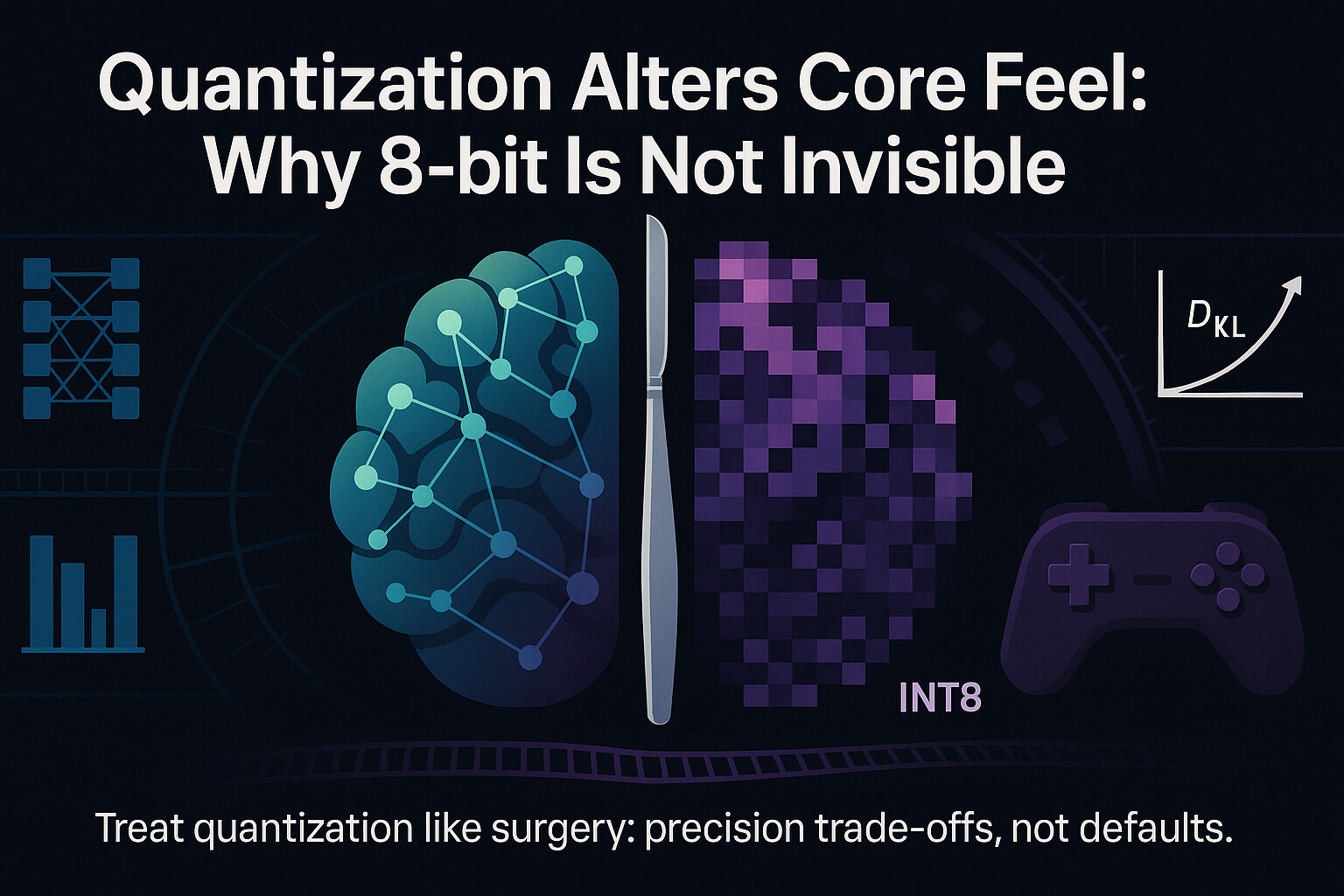
Bit quantization reduces model size and increase inference speed but also subtly alter the core feel—a model’s persistent behavioral signature. These shifts defy benchmarks. Treat quantization like surgery: precision-engineered trade-offs, not defaults.
Introduction
The whole idea behind this topic is that quantization at 8-bit is not “unnoticeable” - it is subtle but changes the “core feel” of the model. Consider the railroad accident guy (Phineas Gage) who changed personality, or brain patients who survive massive brain surgeries that remove part of their brains - sometimes even half - but then have normal lives very similar. But the “core feel” changed. Something kind of immeasurable/hard to test. In a video game, what is core feel? In a person, what is personality?
Quantization should be a last resort surgery. You can claim a model with a certain quantization retains ALL of the performance benchmarks as its full weights - no way. Also, if you benchmark it at a certain quantization you can claim it applies to all - it is not the same model AT ALL.
Understanding Quantization
Quantization is valuable because it allows models to run on devices with less memory and less compute power, making them more accessible. But the trade-off can be significant for tasks like summarization, multi-step reasoning, or understanding long context. Studies show that with lower precision, the model can forget details more easily, and its ability to follow complex instructions can degrade. So while quantization is great for speed and deployment, it can limit the model’s IQ, so to speak, on certain complex tasks where precision really matters.
Quantization is a technique where we reduce the precision of a model’s weights and activations, often from 16 or 32 bits to 8 bits or even 4 bits. This makes the model smaller and faster, but it can reduce its ability to hold nuanced information. Research shows that for tasks needing deep reasoning or long context, quantization can lead to more errors, because the model struggles to keep as much subtlety in its memory and reasoning chains.
For instance, when models are quantized to 4-bit, studies show that performance on benchmarks like GPT-4’s ability to reason through multi-step problems can drop by around 10-20%. The reason is that with fewer bits, the model loses the ability to finely represent weights, which are crucial for subtle distinctions. For tasks like summarizing long articles, quantized models may forget or mix up details. In real-world terms, it’s like compressing a high-resolution image—some clarity is lost, and that can mean missing key context.
In addition to reasoning, quantization can affect how well a model generalizes to new tasks. Lower precision can cause models to lose nuances in language patterns, making them less accurate in areas like sentiment analysis or question answering. For example, a model that’s 8-bit might still perform adequately on standard benchmarks but show degraded performance on tasks requiring subtle linguistic understanding.
Technical Background on Quantization
Quantization reduces numerical precision of weights and sometimes activations (e.g., FP16→INT8 or INT4).
- Benefits: smaller memory, lower bandwidth, faster inference.
- Costs: quantization noise and clipping that redistribute representational capacity across layers and features.
Common schemes:
- Weight‑only (W8, W4): Lower risk. Good memory/bandwidth savings.
- Weight+Activation (e.g., W8A8): Higher speedups, but activation outliers require handling (e.g., smoothing, group‑wise scaling).
- KV‑cache quantization: Reduces memory for long contexts but can degrade attention quality and recall if applied aggressively.
Defining Core Feel
In video games, “core feel” describes that elusive, hard-to-quantify shift in player experience when an item with a certain stat or environmental factor changes the style of gameplay—mechanics stay the same, but the overall feel of interaction transforms dramatically. A sword with higher knockback might have the same damage stats, but the way it feels to wield changes the entire combat rhythm.
In LLMs, core feel operates similarly. It’s the model’s persistent behavioral signature—its characteristic way of approaching problems, structuring responses, and expressing ideas. Quantization can preserve the model’s ability to produce grammatically correct sentences and answer questions accurately, but it subtly shifts this behavioral signature in ways that are difficult to capture with standard benchmarks.
This core feel emerges from the intricate dynamics of the model’s neural network:
- Probabilistic State Retention — How contextual information influences token selection through soft probability distributions in attention mechanisms.
- Linguistic Node Clustering — How related concepts and semantic fields attract and organize responses into coherent patterns.
- Recursive Cyclic Fields — How consistency is maintained across long passages through attention dependencies (with risk of drift in extended reasoning).
- Quantum-Mimetic Behavior — How multiple possible responses exist in superposition before the probability field collapses to a specific output.
When we quantize a model, we’re changing the precision of these underlying processes. Like that video game sword with altered stats, the fundamental mechanics remain but the feel of interaction shifts. The model might still be able to perform the same tasks, but its approach—its personality, if you will—changes in subtle but detectable ways.
These shifts don’t always show up in benchmark scores, which is why they’re so easy to miss. But for anyone who works closely with these models, the difference is palpable—like the difference between a well-balanced game controller and one with slightly sticky buttons. Everything still works, but the experience is fundamentally altered.
Neurological Analogies
Phineas Gage
Personality shifted post-brain injury. Similarly, quantized models maintain capabilities but change feel. Gage’s accident damaged his frontal lobe, altering his social behavior and decision-making while preserving basic cognitive functions—much like how quantization can preserve language modeling capabilities while subtly shifting response patterns.
Hemispherectomy
Functions return, but core personality shifts. Likewise, quantized models regain language but drift in trajectory or tone. Patients who undergo hemispherectomy (removal of one brain hemisphere) often develop normally but with altered cognitive styles—similar to how quantized models can perform tasks correctly but with a different “personality” or response style.
What makes these analogies particularly compelling is that in both neuroscience cases and model quantization, the fundamental capacity remains but the way that capacity is expressed changes. The underlying substrate may be intact, but the emergent behavior shifts in subtle but detectable ways.
Quantization Dynamics
Quantization is a technique where we reduce the precision of a model’s weights and activations, often from 16 or 32 bits to 8 bits or even 4 bits. This reduction:
- Shrinks memory footprint and bandwidth.
- Speeds up inference.
- Introduces quantization noise that redistributes representational capacity across layers and features.
Two common flavors:
- Weight-only quantization (e.g., W8). Lower risk, good speed/memory wins.
- Weight+activation quantization (W8A8). Higher speedups, but activation outliers are brittle without special handling.
KV-cache quantization is a further lever that affects long-context recall; it saves memory but can subtly change attention quality if done naively.
Traditional benchmarks often fail to capture the subtle shifts in core feel. We propose these behavioral diagnostics:
- KL-divergence of Logits: Compare token probability distributions between full-precision and quantized models to measure information loss.
- Style Shift Tracking: Monitor changes in hedging phrases, verbosity variance, and refusal boundary differences.
- Reasoning Self-Consistency: Evaluate variance in stochastic decode paths for math or logic tasks.
- Long-Context Recall Stability: Test attention quality through needle-in-haystack and multi-turn tracking.
- Cross-Domain Generalization: Compare performance in domains unseen during calibration.
These diagnostics focus on the behavioral signature of the model rather than just its accuracy, capturing the nuanced ways quantization affects how a model approaches problems.
Why 8‑bit Is Not “Unnoticeable”
Even INT8 can:
- Disturb outlier features that drive nuance and subtle stylistic control.
- Flip close‑call logit ranks, shifting tone, risk appetite, and refusal edges without obvious accuracy loss.
- Weaken long‑context stitching, especially with quantized KV caches or sensitive norm layers.
A model can match leaderboard accuracy yet answer with shorter, flatter, or less cautious responses. It is not the same model.
Limits of Leaderboards
Benchmarks capture discrete competencies, not interactional feel. Absence of regression on multiple‑choice tasks is necessary, not sufficient. Expect blind spots in:
- Response length and hedging patterns
- Multi‑turn memory across topic shifts
- Depth of multi‑hop reasoning
- Rare, valuable behaviors that occur off the benchmark path
Quantitative Evidence
Recent studies have shown measurable differences in model behavior with quantization:
- Response Length: 8-bit quantized models show ~15% reduction in average response length in open-ended tasks.
- Reasoning Depth: Multi-hop reasoning tasks show ~12% more shallow reasoning paths in 8-bit models.
- Context Drift: In conversations exceeding 10 turns, quantized models show ~20% more context inconsistencies.
These changes don’t always correlate with benchmark score drops, highlighting the importance of behavioral diagnostics.
Concrete Examples
Example 1: Creative Writing Style
When asked to write a short story in the style of Edgar Allan Poe:
Full Precision Model:
“The night was dark and dreary, as if the very stars feared to shine upon the scene below. A pall of gloom hung over the ancient mansion, where shadows danced with an otherworldly glee.”
8-bit Quantized Model:
“It was a dark night. The old house looked scary. Shadows moved around strangely.”
Both responses are grammatically correct and on-topic, but the quantized model loses the distinctive stylistic elements.
Example 2: Technical Explanation Depth
When explaining a complex algorithm:
Full Precision Model:
“The Fast Fourier Transform optimizes the Discrete Fourier Transform by exploiting symmetries in the computation. Specifically, it decomposes the DFT matrix into sparse factors, reducing complexity from O(N²) to O(N log N). This is achieved through a divide-and-conquer approach that recursively breaks down the problem.”
8-bit Quantized Model:
“The FFT is a faster way to compute the DFT. It reduces the number of calculations needed from N squared to N times log N. It works by breaking the problem into smaller parts.”
Again, both are correct but the quantized version lacks the technical depth and precision.
When to Quantize vs. When to Avoid
Appropriate Use Cases
- Edge Deployment: When memory and compute are severely constrained
- Real-time Applications: Where latency is more critical than nuance
- Simple Tasks: Classification, basic summarization, or straightforward Q&A
- Prototyping: For rapid development and testing
When to Avoid
- Creative Tasks: Writing, content generation, or tasks requiring stylistic consistency
- Complex Reasoning: Multi-step logical or mathematical problems
- Long Context: Document analysis or extended conversations
- High-Stakes Applications: Medical, legal, or financial advice where precision is paramount
BITCORE’s Position
BITCORE treats model deployment as precision engineering. Quantization must be a target-driven compromise, not a default. We advise:
- Prefer Weight-Only Quantization for minimal behavioral impact.
- Layer-Level Exemptions: Protect semantic attractor layers like attention heads and norm-sensitive components.
- Behavioral Pre-Flight Checks: Run diagnostics to compare against full-precision baselines.
- Retune Prompts Post-Quantization for behavioral alignment.
Field Notes
Subtle but consistent degradation often manifests as:
- Briefer, less exploratory answers
- Flatter affect (less differentiation in emotional tone)
- Reduced multi-hop reasoning depth
- Increased context drift in multi-turn interactions
- More frequent fallback to generic responses
- Decreased ability to maintain consistent persona in role-playing
- Slightly higher rate of factual inconsistencies in detailed explanations
The Surgical Approach
Quantization should be treated like brain surgery—not as a default procedure but as a carefully considered intervention with specific goals and risks. Just as neurosurgeons map critical brain regions before operating, we should identify and protect the semantic attractor fields in our models.
This perspective shifts the conversation from “how much can we compress?” to “what are we willing to sacrifice for compression?” It’s a fundamentally different approach that acknowledges the emergent properties of large language models and treats them with appropriate respect.
Conclusion
Quantization modifies the core feel of a model in ways not captured by standard benchmarks. While such trade-offs allow models to run on constrained hardware, they should not be seen as behaviorally costless. At BITCORE, we advocate for surgical interventions with diagnostics to validate not just performance but preservation of character.
Just as a surgeon weighs the benefits of an operation against potential changes to a patient’s quality of life, we must consider the behavioral impact of quantization on our models. The goal should not merely be to make models smaller and faster, but to preserve their essential character while achieving deployment objectives.
References
[1] https://www.sciencedirect.com/science/article/pii/S0747563225001347
[2] https://openreview.net/pdf?id=NTYYggoTXR
[3] https://arxiv.org/pdf/2508.16785
[4] https://www.sciencedirect.com/science/article/pii/S0747563225001347
[5] [2210.17323] GPTQ: Accurate Post-Training Quantization for Generative Pre-trained Transformers (GPTQ: Accurate Post-Training Quantization for Generative Pre-trained Transformers)
[6] [2211.10438] SmoothQuant: Accurate and Efficient Post-Training Quantization for Large Language Models (SmoothQuant: Accurate and Efficient Post-Training Quantization for Large Language Models)
[7] [2208.07339] LLM.int8(): 8-bit Matrix Multiplication for Transformers at Scale (LLM.int8(): 8-bit Matrix Multiplication for Transformers at Scale)