Cognitive Capital: The Missing Layer Between Knowledge and Work

Toward a Theory of Durable Reasoning Assets
Thesis
Modern organizations do not mainly lack information. They lack durable reasoning.
They create meetings, chats, notes, reports, dashboards, tickets, decisions, summaries, and AI outputs every day. Much of that work is useful once, then disappears into private memory, scattered tools, stale documents, or archives no one searches.
Cognitive capital names the portion of thought that survives the moment and remains useful. It is reusable reasoning capacity: explanations, models, assumptions, decision logic, evidence trails, correction histories, workflows, maps, and shared memory that help future people or systems think, decide, build, and learn better.
Human capital theory already treats education, training, and skill as productive investment embodied in people. Becker gives the economic foundation for seeing learned capability as capital. Cognitive capital extends that logic from the trained person to the reusable reasoning structure that can outlast the original thinker. (Becker, Human Capital)
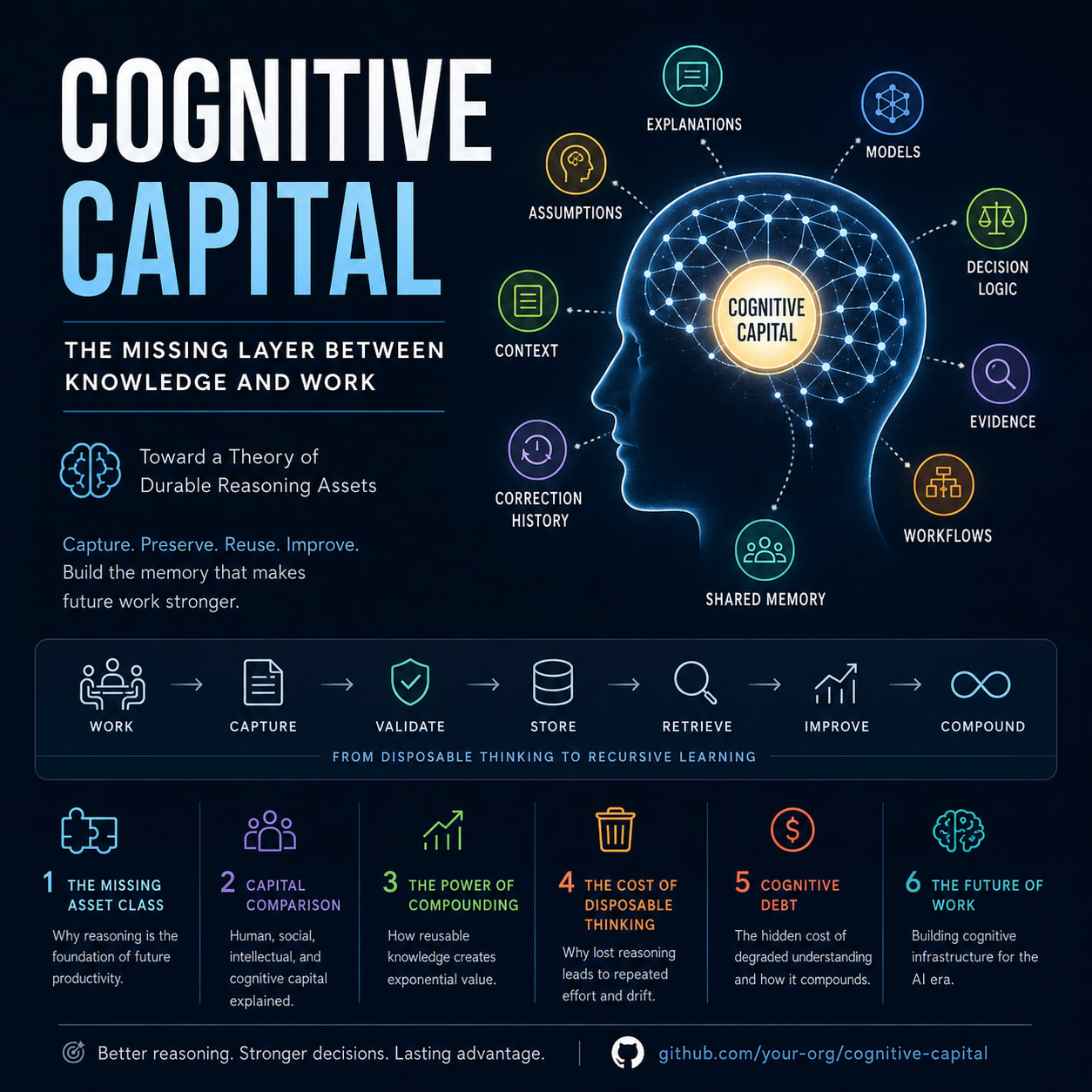
Chapter 1 — Cognitive Capital: The Missing Asset Class
Core claim
Cognitive capital is reusable reasoning capacity that turns thought into a durable productive asset.
Capital is stored productive capacity. A machine can produce future output. A trained worker can apply future skill. A trusted brand can reduce future friction. Cognitive capital performs a similar role for thought: it stores reasoning so future work begins from a stronger base.
Information is not enough. A transcript may contain every word of a meeting and still fail to preserve the logic that mattered. A folder may contain thousands of files and still leave people unable to explain why a decision was made. Knowledge becomes cognitive capital only when it can be used later.
The unit of value is not the answer
The most valuable unit is often the path that made the answer usable.
| Reasoning element | Why it matters |
|---|---|
| Problem | Defines what was being solved |
| Context | Shows the situation around the decision |
| Assumptions | Makes hidden premises visible |
| Evidence | Shows what the claim depends on |
| Alternatives | Prevents old debates from restarting blindly |
| Tradeoffs | Preserves judgment, not just output |
| Decision | Records the chosen direction |
| Revision criteria | Shows when the answer should change |
| Reuse pattern | Turns one answer into a method |
Nonaka’s theory of organizational knowledge creation treats knowledge as movement between tacit and explicit forms. Private judgment becomes organizationally useful when it can be articulated, combined, shared, and internalized by others. (Nonaka, 1994)
Cohen and Levinthal’s concept of absorptive capacity adds the compounding mechanism: prior related knowledge helps an organization recognize, assimilate, and use new knowledge. Cognitive capital is not passive storage. It improves future learning capacity. (Cohen & Levinthal, 1990)
What makes thought into capital
Cognitive capital has four tests:
| Test | Meaning |
|---|---|
| Preserved | The reasoning does not live only in someone’s head |
| Retrievable | People or systems can find it |
| Trusted | It has sources, context, ownership, or validation |
| Reusable | It helps future understanding, decisions, or work |
Walsh and Ungson’s organizational-memory framework supports this wider view of memory. Organizational memory is distributed across individuals, culture, structures, procedures, physical settings, and external archives. (Walsh & Ungson, 1991)
Cognitive capital is not generic knowledge
| Layer | Simple meaning | Example |
|---|---|---|
| Data | Raw records | Logs, messages, numbers |
| Information | Interpreted data | Revenue declined |
| Knowledge | Understood meaning | Churn caused the decline |
| Reasoning | Structured explanation | Churn rose after pricing changed because a segment lost value alignment |
| Cognitive capital | Reusable reasoning | Pricing analysis, churn model, decision record, correction criteria |
%%{init: {"theme": "base", "themeVariables": {
  "fontFamily": "Inter, Arial, sans-serif",
  "primaryColor": "#EEF2FF",
  "primaryTextColor": "#111827",
  "primaryBorderColor": "#6366F1",
  "lineColor": "#64748B"
}}}%%
flowchart TD
    A[Raw data] --> B[Information]
    B --> C[Knowledge]
    C --> D[Structured reasoning]
    D --> E[Cognitive capital]

    E --> F[Reusable decisions]
    E --> G[Reusable workflows]
    E --> H[Reusable explanations]

    classDef weak fill:#F8FAFC,stroke:#CBD5E1,color:#0F172A;
    classDef strong fill:#E0E7FF,stroke:#4F46E5,color:#111827,stroke-width:2px;
    classDef asset fill:#DCFCE7,stroke:#16A34A,color:#052E16,stroke-width:2px;

    class A,B,C weak;
    class D strong;
    class E,F,G,H asset;
Information stores facts. Knowledge stores understanding. Cognitive capital stores reusable reasoning.
Chapter 2 — Cognitive Capital vs. Human, Social, and Intellectual Capital
Core claim
Human capital is embodied skill. Social capital is relational access. Intellectual capital is the broad class of intangible knowledge assets. Cognitive capital is reasoning preserved for future use.
Human capital asks: what can this person do?
Social capital asks: who can this person or group reach and trust?
Intellectual capital asks: what intangible assets create value?
Cognitive capital asks: what reasoning survives and remains usable?
Human capital
Human capital lives in people: education, training, skill, experience, expertise, and judgment. Becker treats education and training as investments because they can increase future productive capacity. (Becker, Human Capital)
A senior engineer’s experience is human capital. It becomes cognitive capital when captured as design rationale, review heuristics, debugging patterns, decision records, workflows, or teaching material.
Social capital
Social capital lives in relationships. Bourdieu defines it as resources linked to durable networks of mutual recognition and membership. (Bourdieu, The Forms of Capital) Coleman frames social capital as a feature of social structure that enables action. (Coleman, 1988)
Social capital helps people gain access to expertise, trust, introductions, cooperation, and credibility. But it is not preserved reasoning. A team may know who to ask, but if the person is gone or unreachable, the reasoning may vanish.
Intellectual capital
Intellectual capital includes intangible assets such as expertise, patents, processes, databases, systems, software, routines, customer relationships, brand equity, and institutional know-how.
Cognitive capital is the reasoning-specific layer inside that broader field.
A patent can be intellectual capital. It contains cognitive capital when it preserves a method, model, or technical logic.
A database can be structural capital. It becomes cognitive capital when it helps people infer, decide, explain, or act better.
A policy can be intellectual capital. It becomes cognitive capital when it preserves the reasoning behind the rule.
Transactive memory as a bridge
Wegner’s theory of transactive memory explains how groups remember by distributing knowledge across people and tracking “who knows what.” It bridges social and cognitive capital because group memory depends on people, relationships, and communication. (Wegner, 1987)
But transactive memory is vulnerable. If the expert leaves or the map of expertise goes stale, the group loses access. Cognitive capital asks whether the reasoning has been externalized enough to survive without the original person.
| Category | Main question | Stored in | Typical asset | Failure mode |
|---|---|---|---|---|
| Human capital | What can this person do? | People | Skill, expertise, judgment | Leaves with people |
| Social capital | Who can access whom? | Relationships | Trust, reputation, networks | Breaks when ties change |
| Intellectual capital | What intangible assets create value? | Organization | IP, systems, brand, databases | Too broad to isolate reasoning loss |
| Cognitive capital | What reasoning survives? | Artifacts, systems, routines, memory | Decision logic, models, workflows | Decays when context is lost |
%%{init: {"theme": "base", "themeVariables": {
  "fontFamily": "Inter, Arial, sans-serif",
  "primaryColor": "#F5F3FF",
  "primaryTextColor": "#111827",
  "primaryBorderColor": "#8B5CF6",
  "lineColor": "#64748B"
}}}%%
flowchart TD
    A[Intellectual capital<br/>broad intangible value]

    A --> B[Human capital<br/>skill in people]
    A --> C[Social capital<br/>value in relationships]
    A --> D[Structural capital<br/>systems and processes]
    A --> E[Cognitive capital<br/>reusable reasoning]

    E --> F[Decision logic]
    E --> G[Reusable models]
    E --> H[Shared memory]

    classDef broad fill:#F5F3FF,stroke:#7C3AED,color:#111827,stroke-width:2px;
    classDef capital fill:#F8FAFC,stroke:#CBD5E1,color:#0F172A;
    classDef cog fill:#DBEAFE,stroke:#2563EB,color:#0F172A,stroke-width:2px;
    classDef output fill:#DCFCE7,stroke:#16A34A,color:#052E16;

    class A broad;
    class B,C,D capital;
    class E cog;
    class F,G,H output;
Intellectual capital asks what intangible assets create value. Cognitive capital asks what reusable reasoning creates future thinking capacity.
Chapter 3 — The Compounding Value of Reusable Knowledge
Core claim
Reusable knowledge compounds when it is captured, validated, corrected, connected, and fed back into future work.
A knowledge artifact becomes valuable when it changes the starting point of the next task. Without reuse, every problem begins from near zero. People research again, explain again, debate again, validate again, and rebuild again.
With cognitive capital, future work starts from a prepared base.
Why prior knowledge compounds
Absorptive capacity is the strongest foundation here. Cohen and Levinthal argue that an organization’s ability to recognize, assimilate, and apply new knowledge depends heavily on prior related knowledge. What an organization already understands shapes what it can learn next. (Cohen & Levinthal, 1990)
A good reference base makes future research faster.
A decision log makes future strategy clearer.
A workflow makes repeated execution cheaper.
A conceptual map makes new information easier to place.
A correction history prevents the same mistake from repeating.
The conversion cycle
Nonaka’s model gives the conversion pattern: tacit knowledge becomes explicit; explicit knowledge combines with other explicit knowledge; people internalize the result through practice. (Nonaka, 1994)
In practical terms:
Someone learns something.
They express it.
Others connect it to existing knowledge.
The group uses it.
Use reveals errors or gaps.
The corrected version becomes a better input for the next cycle.
This is recursive learning in grounded organizational form.
Strategy and adaptation
Dynamic-capabilities theory adds the strategic layer. Teece, Pisano, and Shuen frame advantage around a firm’s ability to integrate, build, and reconfigure internal and external competences in changing environments. (Teece, Pisano & Shuen, 1997)
Reusable knowledge matters because adaptation requires memory. A group cannot reconfigure what it cannot understand. It cannot improve what it cannot inspect.
| Mechanism | Effect |
|---|---|
| Retrieval | People find what was already learned |
| Validation | Users know what is trusted and why |
| Recombination | Ideas connect across domains |
| Correction | Errors improve the shared artifact |
| Transfer | New people inherit reasoning, not just instructions |
| Standardization | Repeated work becomes workflow |
| Abstraction | One solved case becomes a reusable pattern |
%%{init: {"theme": "base", "themeVariables": {
  "fontFamily": "Inter, Arial, sans-serif",
  "primaryColor": "#ECFDF5",
  "primaryTextColor": "#052E16",
  "primaryBorderColor": "#10B981",
  "lineColor": "#64748B"
}}}%%
flowchart LR
    A[Work output] --> B[Capture]
    B --> C[Validate]
    C --> D[Organize]
    D --> E[Reuse]
    E --> F[Correct]
    F --> D
    E --> G[Lower future effort]

    classDef step fill:#F8FAFC,stroke:#CBD5E1,color:#0F172A;
    classDef loop fill:#D1FAE5,stroke:#059669,color:#052E16,stroke-width:2px;
    classDef payoff fill:#FEF3C7,stroke:#D97706,color:#451A03,stroke-width:2px;

    class A,B,C step;
    class D,E,F loop;
    class G payoff;
Reusable knowledge compounds because every validated reasoning artifact lowers the cost of future understanding.
Chapter 4 — The Cost of Disposable Thinking
Core claim
Disposable thinking wastes intelligence by producing outputs without preserving the reasoning needed to reuse or improve them.
Disposable thinking can be excellent in the moment. The failure is that it dies after use.
A meeting resolves a hard tradeoff, but only the final choice is recorded.
A research thread finds the answer, but no one extracts the reasoning.
A senior person explains a difficult concept, but the explanation vanishes into chat history.
A team rejects four options, then restarts the same debate later because no one preserved why those options failed.
An AI system produces a useful answer, but no one verifies, cites, stores, or converts it into reusable knowledge.
Memory is not automatic
Walsh and Ungson argue that organizational memory is distributed across people, culture, transformations, structures, ecology, and external archives. (Walsh & Ungson, 1991) Casey and Olivera’s review describes organizational-memory research as fragmented, reinforcing the practical point: organizations remember unevenly. (Casey & Olivera)
If memory is not designed, it decays into folklore, private recollection, stale documents, inaccessible archives, or “ask the person who remembers.”
Lost assumptions
Argyris’ double-loop learning is central here. Single-loop learning corrects actions. Double-loop learning questions the policies, objectives, assumptions, and norms behind those actions. (Argyris, 1977)
Disposable thinking blocks double-loop learning because the organization loses the material needed to inspect its own assumptions. It may preserve a decision but not the reasoning that made the decision valid.
Decision loss is worse than document loss
A lost document is a storage problem.
A lost rationale is a reasoning problem.
Architecture Decision Records are a practical countermeasure.
Architecture Decision Record (ADR): a short document that records an important design decision, the context behind it, the alternatives considered, and the consequences of the choice.
An ADR captures an important decision with its context and consequences. (ADR project) AWS guidance similarly describes ADRs as records of significant architectural choices, their context, and their consequences. (AWS ADR guidance)
| Symptom | Hidden cause |
|---|---|
| Repeated meetings | Earlier reasoning was not reusable |
| Slow onboarding | New people inherit tasks without context |
| Repeated research | Findings were not converted into assets |
| Conflicting explanations | No trusted source of reasoning exists |
| Reopened debates | Rejected alternatives were not documented |
| Strategy drift | Assumptions changed without trace |
| Expert dependency | Knowledge stayed in heads |
| AI output overload | Generated material was not validated or integrated |
%%{init: {"theme": "base", "themeVariables": {
  "fontFamily": "Inter, Arial, sans-serif",
  "primaryColor": "#FFF7ED",
  "primaryTextColor": "#111827",
  "primaryBorderColor": "#F97316",
  "lineColor": "#64748B"
}}}%%
flowchart TD
    A[Meeting / research / AI output] --> B{Reasoning preserved?}
    B -->|Yes| C[Cognitive capital]
    B -->|No| D[Disposable thinking]

    C --> E[Reuse]
    C --> F[Improvement]
    D --> G[Repeated work]
    D --> H[Lost context]
    D --> I[Slow decisions]

    classDef question fill:#FEF3C7,stroke:#D97706,color:#451A03,stroke-width:2px;
    classDef good fill:#DCFCE7,stroke:#16A34A,color:#052E16,stroke-width:2px;
    classDef bad fill:#FEE2E2,stroke:#DC2626,color:#450A0A,stroke-width:2px;
    classDef neutral fill:#F8FAFC,stroke:#CBD5E1,color:#0F172A;

    class A neutral;
    class B question;
    class C,E,F good;
    class D,G,H,I bad;
Disposable thinking converts intelligence into exhaust. Cognitive capital converts intelligence into infrastructure.
Chapter 5 — Cognitive Debt
Core claim
Cognitive debt is the future cost of degraded understanding.
Technical debt gives the parent metaphor. Fowler describes technical debt as internal-quality deficiencies that make future software modification harder; the extra future effort is the “interest” paid on the debt. (Fowler, Technical Debt)
Cognitive debt applies the same logic to understanding. It appears when progress is made without preserving the reasoning required to maintain, explain, verify, or extend that progress.
What cognitive debt looks like
The system works, but no one remembers why.
The policy exists, but no one knows what problem it solved.
The workflow runs, but its assumptions are stale.
The team has documents, but nobody trusts them.
The AI output was accepted, but no one can prove it.
The expert left, and the rationale left with them.
This debt is paid in confusion.
| Debt type | Meaning | Example |
|---|---|---|
| Technical debt | Future cost from weak system quality | Messy architecture slows new work |
| Documentation debt | Future cost from missing or stale documentation | Docs no longer match reality |
| Knowledge debt | Future cost from missing organizational knowledge | Only one person knows the process |
| Intent debt | Future cost from missing purpose or rationale | No one knows why the design exists |
| Cognitive debt | Future cost from degraded understanding | People cannot reason clearly about the system |
The interest rate
Cognitive debt accumulates interest through slower decisions, heavier reviews, fragile handoffs, excessive meetings, duplicated effort, poor onboarding, false certainty, stale assumptions, hidden dependencies, and unsafe change.
ADRs reduce this debt by documenting decisions, alternatives, context, justifications, constraints, and implications. Microsoft’s ADR guidance describes ADRs as records of key decisions, ruled-out alternatives, context, justifications, and implications. (Microsoft ADR guidance)
AI and cognitive debt
AI increases the risk because it can generate more output than an organization can validate. If AI-produced work is accepted without source trails, assumptions, ownership, review, and integration, the organization may produce more content while understanding less.
McKinsey’s 2025 AI survey reports that high-performing AI organizations are more likely to define processes for when model outputs require human validation. It also links workflow redesign, leadership ownership, governance, infrastructure, and adoption practices with capturing value from AI. (McKinsey, 2025 State of AI)
%%{init: {"theme": "base", "themeVariables": {
  "fontFamily": "Inter, Arial, sans-serif",
  "primaryColor": "#EFF6FF",
  "primaryTextColor": "#0F172A",
  "primaryBorderColor": "#2563EB",
  "lineColor": "#64748B"
}}}%%
flowchart LR
    A[Missing rationale] --> B[Cognitive debt]
    B --> C[Confusion]
    B --> D[Rework]
    B --> E[Unsafe change]

    F[Decision records] --> I[Reduced debt]
    G[Validation] --> I
    H[Maintained memory] --> I

    classDef debt fill:#FEE2E2,stroke:#DC2626,color:#450A0A,stroke-width:2px;
    classDef fix fill:#DCFCE7,stroke:#16A34A,color:#052E16,stroke-width:2px;

    class A,B,C,D,E debt;
    class F,G,H,I fix;
Technical debt is paid in rework. Cognitive debt is paid in confusion.
Chapter 6 — The Future of Work Is Cognitive Infrastructure
Core claim
The future of work belongs to systems that convert work into recursive, verifiable, reusable learning loops.
The next productivity layer is not simply more apps. Most organizations already have too many apps. The harder problem is fragmentation: knowledge is scattered across email, chat, documents, meetings, dashboards, tickets, slide decks, private notes, personal memory, and AI tools.
More summaries do not mean more understanding.
More answers do not mean better judgment.
More agents do not mean better coordination.
More documents do not mean stronger memory.
The infrastructure layer
Cognitive infrastructure is the system that turns work into durable reasoning assets.
| Infrastructure element | Function |
|---|---|
| Source-backed references | Makes claims checkable |
| Maintained knowledge bases | Keeps memory usable |
| Decision records | Preserves rationale |
| Workflow memory | Makes repeated work easier |
| Validation standards | Separates trusted from untrusted output |
| Correction logs | Turns errors into learning |
| Reusable explanations | Reduces repeated teaching |
| Shared taxonomies | Makes knowledge easier to organize |
| Context retrieval | Supplies relevant memory |
| Ownership trails | Shows who maintains what |
| Review processes | Protects quality |
| Human judgment checkpoints | Keeps automation accountable |
| Feedback loops | Converts use into improvement |
McKinsey’s 2025 AI survey supports the urgency: high-performing AI organizations are more likely to redesign workflows, scale agents, show senior leadership ownership, and define when model outputs need human validation. (McKinsey, 2025 State of AI)
Recursive learning
Recursive learning belongs at the center:
Work produces artifacts.
Artifacts shape future work.
Future work corrects earlier artifacts.
Corrected artifacts become better inputs for the next cycle.
This connects several established fields. Argyris explains why mature learning must challenge assumptions, not only correct actions. (Argyris, 1977) Cohen and Levinthal show why prior knowledge improves future learning. (Cohen & Levinthal, 1990) Teece, Pisano, and Shuen explain why organizations need dynamic capabilities to integrate, build, and reconfigure competences under change. (Teece, Pisano & Shuen, 1997)
In the AI era, model access becomes less rare. Durable advantage shifts toward better context, cleaner memory, stronger evaluation, richer feedback, and deeper integration into real work.
From app-centric work to memory-centric work
The app-centric organization asks:
Where is the task? Where is the document? Where is the chat? Where is the dashboard?
The memory-centric organization asks:
What did we learn? What do we trust? Why did we decide this? What changed? What can be reused? What should be corrected?
%%{init: {"theme": "base", "themeVariables": {
  "fontFamily": "Inter, Arial, sans-serif",
  "primaryColor": "#EFF6FF",
  "primaryTextColor": "#0F172A",
  "primaryBorderColor": "#2563EB",
  "lineColor": "#64748B"
}}}%%
flowchart TD
    A[Work] --> B[Artifact]
    B --> C[Validate]
    C --> D[Store in memory]
    D --> E[Retrieve in future work]
    E --> F[Correct and improve]
    F --> D
    D --> G[Cognitive capital]

    classDef work fill:#F8FAFC,stroke:#CBD5E1,color:#0F172A;
    classDef system fill:#DBEAFE,stroke:#2563EB,color:#0F172A,stroke-width:2px;
    classDef asset fill:#DCFCE7,stroke:#16A34A,color:#052E16,stroke-width:2px;

    class A,B work;
    class C,D,E,F system;
    class G asset;
AI increases the supply of output. Cognitive infrastructure determines whether that output becomes learning.
Summary
Cognitive capital is the productive value of reusable reasoning.
It is not a synonym for information.
It is not merely documentation.
It is not identical to human capital, though it often begins in human expertise.
It is not identical to social capital, though relationships help transmit it.
It is not identical to intellectual capital, though it belongs inside that broader family of intangible assets.
| Concept | Simple definition |
|---|---|
| Human capital | What people can do |
| Social capital | Who people can reach and trust |
| Intellectual capital | Intangible assets that create value |
| Cognitive capital | Reusable reasoning that improves future thought |
| Cognitive debt | The cost of degraded understanding |
| Cognitive infrastructure | Systems that preserve, verify, retrieve, and compound reasoning |
The future advantage is not having more information. It is preserving better reasoning.